
Rabies
A zoonotic viral disease causing fatal encephalitis unless treated before symptoms.

Own Work · CC BY-SA 4.0
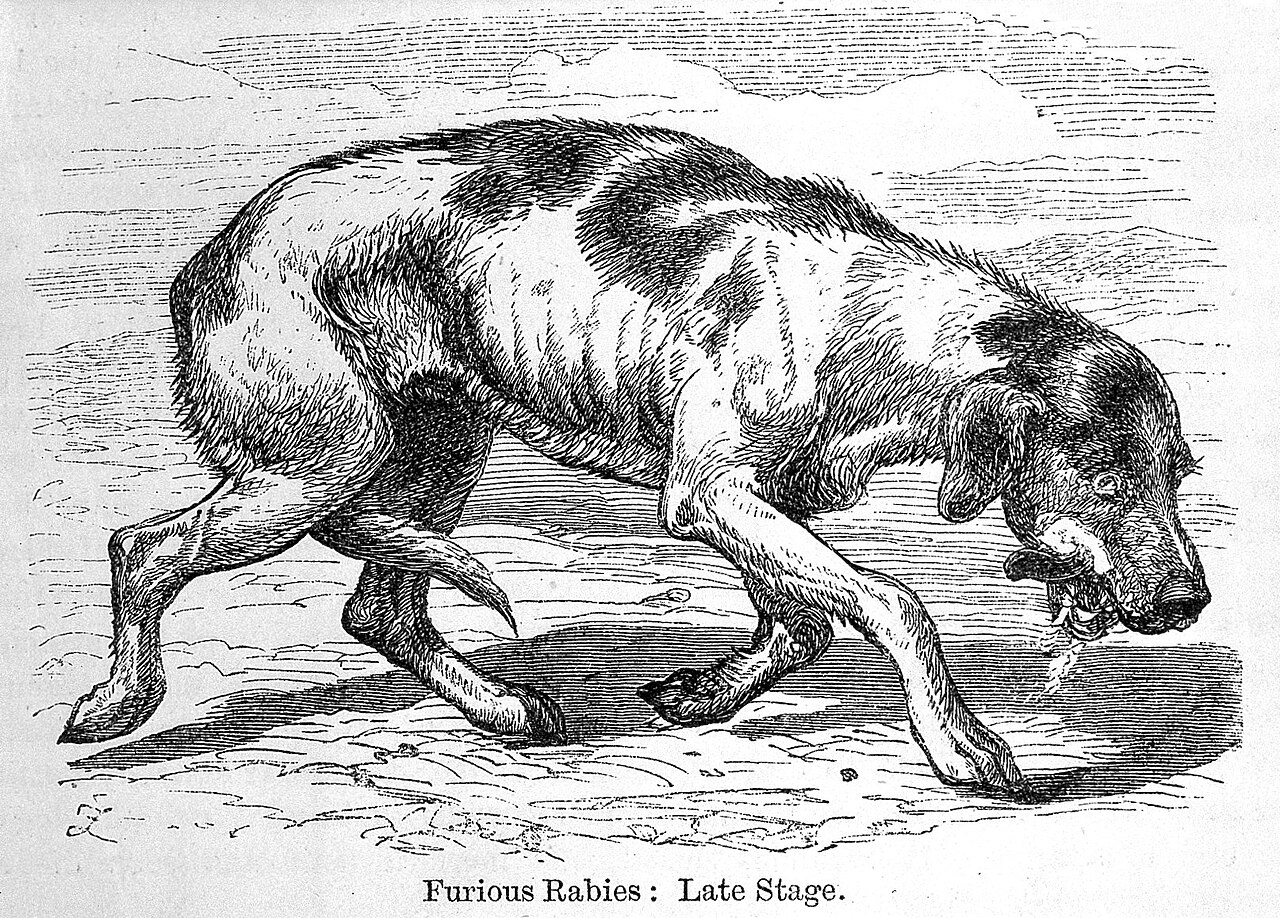
Rabies is a zoonotic viral disease caused by lyssaviruses, including the rabies virus and Australian bat lyssavirus. It causes acute and severe encephalitis in humans and other mammals and was historically referred to as hydrophobia due to the painful throat spasms that occur when attempting to drink. Once symptoms appear, the result is virtually always death, though prompt prophylactic treatment can prevent the disease if administered before symptoms begin.
- Caused by
- Lyssaviruses (including rabies virus and Australian bat lyssavirus)
- Transmission
- Bites, scratches, or saliva contact with mucous membranes
- Incubation period
- Usually one to three months, can range from less than one week to more than one year
- Primary animal vector (global)
- Dogs
- Primary animal vector (Americas)
- Bats
- Classification
- Neglected tropical disease
Lore & Background
Rabies has been known since antiquity, with the name derived from the Latin rabies, meaning 'madness', and the Greek lyssa used in the genus name Lyssavirus. The disease is spread when an infected animal bites or scratches a human or other animal, and even saliva contact with eyes, mouth, or nose can transmit it. Globally, dogs are the most common animal involved, with more than 99% of human cases in dog-endemic areas resulting from dog bites. In the Americas, bat bites are the most common source, with less than 5% of cases attributed to dogs. Rodents are very rarely infected.
Reader's Guide
Animal control and vaccination programs have decreased the risk from dogs in many regions, and countries such as Australia, Japan, and much of Western Europe do not have rabies among dogs. The global cost is estimated at US$8.6 billion per year in lost lives, livelihoods, and medical care, besides uncalculated psychological trauma.
Did You Know?
- Once symptoms appear, the result is virtually always death.
- The incubation period is usually one to three months but can vary from less than one week to more than one year.
- Globally, dogs are the most common animal involved in rabies transmission; in the Americas, bat bites are the most common source.
The Hidden Infection: Defining Cryptic Rabies
Cryptic rabies describes a particularly insidious form of the disease in which a person contracts the rabies virus without any identifiable or documented exposure to an infected animal. Unlike cases where a clear animal bite provides a straightforward epidemiological trail, cryptic cases leave clinicians and public health officials searching for a source that may never be found. Phylogenetic analysis of the virus isolated from these patients consistently points back to bats as the original reservoir, even when the individual has no recollection of any bat encounter. Geographically, this unrecognized form of the infection clusters most heavily in the southern United States. The term "cryptic" captures the essential mystery at the heart of these cases: the virus is present, the disease is progressing, yet the precise moment of transmission remains hidden from everyone involved, making prevention and contact tracing extraordinarily difficult for the medical community.
The Bat Species Paradox
One of the most puzzling aspects of cryptic rabies is which bat species actually carry the virus into humans. Silver-haired bats (Lasionycteris noctivagans) and tricolored bats (Perimyotis subflavus) emerge as the two most frequently implicated species in phylogenetic tracing of these infections. Yet this association defies simple logic: both of these species are known to have considerably less contact with humans than other bat species found across the country. The big brown bat, by contrast, is widespread throughout the United States and has a well-documented habit of roosting inside buildings and homes, placing it in regular proximity to people. Despite this greater opportunity for human-bat interaction, the big brown bat does not dominate cryptic case reports. Scientists have not yet fully resolved why the silver-haired and tricolored bats account for the majority of these enigmatic infections, though the prevailing hypothesis centers on the particular virulence of the rabies virus strain maintained within those two species.
Why the Bite Goes Unnoticed
The very name "cryptic" reflects a diagnostic nightmare: the exposure event is invisible to the patient and often to those around them. When a person finally presents with symptoms, they may already be unconscious or incoherent, making it impossible to obtain a reliable personal history of any animal contact. In such situations, friends and family members become the primary source for reconstructing whether a bat bite or other exposure might have occurred days or weeks earlier. Even when a bat bite did happen, it can be extraordinarily difficult to detect. Bites from small bat species may be so minute that they leave no visible mark without magnification equipment, meaning the wound simply goes unnoticed. Beyond bites, the virus can enter the body if infected fluids contact a mucous membrane or an open break in the skin. In rare but devastating cases, rabies has also been transmitted through organ transplantation when a donor unknowingly died of the disease before a diagnosis was ever made.
The Aerosol Question and Viral Virulence
For decades, a controversial hypothesis has suggested that the rabies virus might be transmitted through the air in certain environments. The proposed mechanism requires very specific conditions: an extremely large colony of bats occupying a hot, humid cave with poor ventilation, creating an aerosolized cloud of infectious material. Two human deaths in 1956 and 1959 were initially attributed to this kind of cave-entry aerosol exposure. However, subsequent investigations into both cases concluded that the infections could be adequately explained by other, more conventional routes of transmission, effectively undermining the aerosol theory for those incidents. Modern virological studies have confirmed that airborne spread of rabies is feasible only under those narrow, extreme conditions and is not a realistic concern in typical bat habitats. Meanwhile, the question of why silver-haired and tricolored bats remain the dominant source of cryptic cases persists, with researchers believing the virus strain carried by these species is notably more virulent than strains found in other bat populations.
Gallery



Frequently Asked Questions
Who is Rabies?
Rabies is a zoonotic viral illness caused by lyssaviruses, most notably the rabies virus itself and the Australian bat lyssavirus. It targets the central nervous systems of humans and other mammals, triggering a rapid and devastating brain inflammation.
What are Rabies's powers/role?
Rabies attacks the brain and spinal cord, producing acute encephalitis that leads to painful throat spasms—once the reason it was nicknamed hydrophobia. Its defining trait is that once clinical symptoms manifest, the outcome is almost universally fatal.
How does Rabies's story end?
For the infected individual, the narrative is tragically fixed: once symptoms begin, death follows with near certainty. The only way to alter that ending is through prompt post-exposure prophylaxis administered before any signs appear.
How does Rabies spread?
The virus enters a host through bites, deep scratches, or saliva that reaches mucous membranes. Its incubation window is notoriously variable, stretching from under a week to over a year, though one to three months is the most common range.
More in Diseases And Conditions 1-15
Spotted an error? Know more?
This is a living reference — every entry is fact-audited, and reader corrections feed straight into our audit queue. Suggest an edit · See this site's audit record